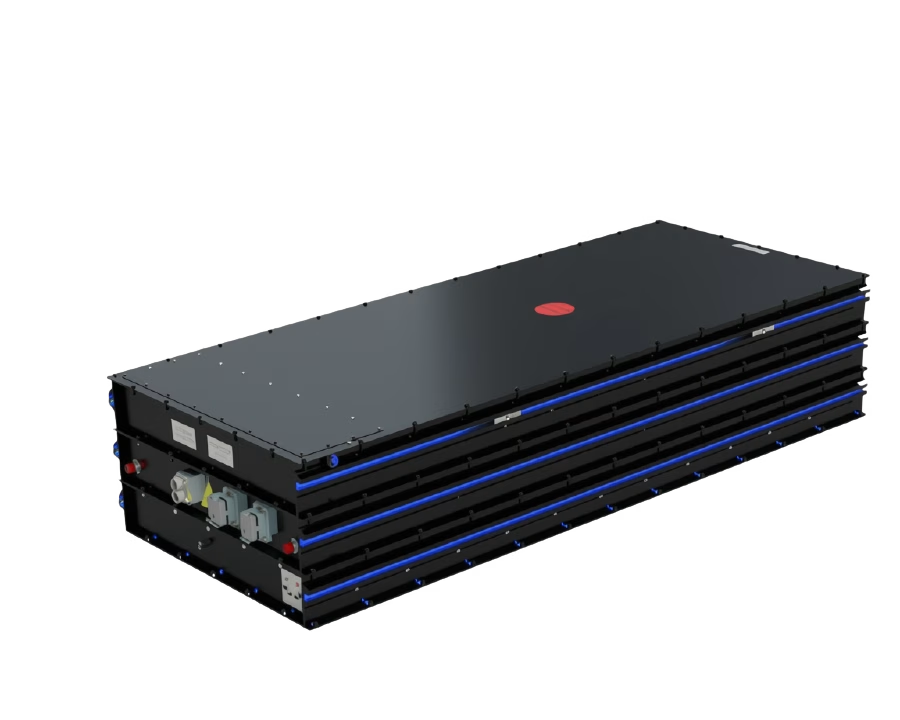
A battery system with seamless integration, high energy density, and mix-and-match flexibility — designed to fit customer needs and optimize vehicle TCO. Available in two installed-energy variants, 88 kWh and 177 kWh, both built on a 180S configuration: 88 runs as 180S1P, 177 pairs two 180S1P strings in parallel within the same system (180S2P).
UVES 4.0 is IMPACT's NMC battery system, available as the 88 variant (180S1P, 88.45 kWh installed) or the 177 variant (two 180S1P strings in parallel — 180S2P, 176.9 kWh installed), both at 520–750V operating voltage. It is compliant with ECE R100.03 and R10.07, UN38.3, and carries an in-house BMS certified as SEooC to ISO 26262 (Functional Safety) and CEooC to ISO 21434 (Cybersecurity).
Four principles carried across every IMPACT battery system, regardless of chemistry or form factor.
Years of R&D and iterative field data feed every generation, so efficiency and cycle life keep climbing without changing the footprint.
No electrochemistry is treated as inherently superior. We match NMC, LFP or LTO to your duty cycle, budget and supply chain constraints.
Every product ships as a fully functional plug-and-play system, engineered, integrated and tested by our own R&D centre from the ground up.
From initial spec alignment to aftersales support, the cooperation plan is scoped around your vehicle or machine platform, not a fixed catalogue part.
| Parameter | 88 kWh | 177 kWh | Test condition |
|---|---|---|---|
| Configuration | 180S1P | 180S2P (two 180S1P strings in parallel) | — |
| Nominal voltage | 648 V | 648 V | Both variants |
| Operating voltage range | 520–750 V | 520–750 V | Both variants |
| Nominal capacity | 136.5 Ah | 273 Ah | @ C/3 discharge, 25°C |
| Installed energy | 88.45 kWh | 176.9 kWh | C/3, 25°C |
| Usable energy | up to 79.6 kWh | up to 159.2 kWh | C/3, 25°C |
| Continuous discharge/charge current | up to 140 A | up to 280 A | Depends on SOC, temperature and DMXC |
| Peak discharge/charge current (@10s) | up to 200 A | up to 400 A | Depends on SOC, temperature and DMXC |
| Dimensions, L×W×H (incl. connectors) | 1091×775×403 mm | 1871×775×403 mm | Tolerance ±5 mm, without bracket |
| Weight | 438 kg | 843–845 kg | Without bracket, ±10 kg |
| Gravimetric energy density | 202 Wh/kg | 209–210 Wh/kg | — |
| LV range | 18–32 V | 18–32 V | — |
| Operating temperature | -30°C to +50/55°C | -30°C to +50/55°C | Charging: -20°C to +50°C |
| Storage temperature | -30°C to 60°C (<30 days) · 0°C to 25°C (>30 days) | -30°C to 60°C (<30 days) · 0°C to 25°C (>30 days) | — |
Segments this configuration is currently positioned for.
NMC's high energy density stretches route range per charge, so trucks cover more distance without adding weight or swapping chemistry.
High energy density lets buses run full-day schedules on fewer, shorter charging stops, without giving up passenger or cargo space.
NMC's energy density extends continuous operating hours between charges, keeping industrial equipment working longer without a charging stop.
Energy density sized for multi-shift municipal duty cycles, so vehicles keep working through the shift without a charging stop.
High energy density supports long working hours on-site in mining and off-highway operations, without stopping to charge.
Energy density sized for frequent-cycle airside operation, minimizing charging downtime between shifts.
Both are built on the same 180S configuration and chemistry. The 88 variant runs a single 180S1P string; the 177 variant runs two 180S1P strings in parallel (180S2P) for roughly double the installed energy (176.9 kWh vs 88.45 kWh) and current capability, in a longer housing.
NMC, across both the 88 and 177 variants.
Public transport (e-bus, intercity, minibus), on-highway commercial (e-truck, e-trailer, municipal road vehicles), and off-highway industrial (construction/mining, port logistics, airport GSE).
Yes. It complies with ECE R100.03 and R10.07, UN38.3, the EMC Directive 2014/30/EU, LVD 2014/35/EU, and EU Battery Regulation 2023/1542, with a Battery Passport.
A complete system. IMPACT's R&D centre develops, integrates and tests the full plug-and-play battery system, including an in-house BMS certified as SEooC to ISO 26262 and CEooC to ISO 21434.
Contact our engineering team through the form below. We start with a requirements alignment call, then scope the specification and integration plan against your vehicle or machine platform.
Send us your platform requirements and duty cycle. Our engineering team will follow up with a scoped proposal.
Book a technical call